Your team may already be using AI. Three rules to set this week
People often try free AI tools on their own, with good intentions and customer details pasted in. Three plain rules that keep the benefit and drop the risk.
Somewhere in your business, someone may already have pasted a customer's email into a free AI tool and asked it for a better reply. It usually works, which is why people keep doing it. The problem is rarely the reply. It's what got pasted in to get it.
Banning it rarely helps. People carry on quietly, and you lose the chance to set it up properly. Three plain rules do more.
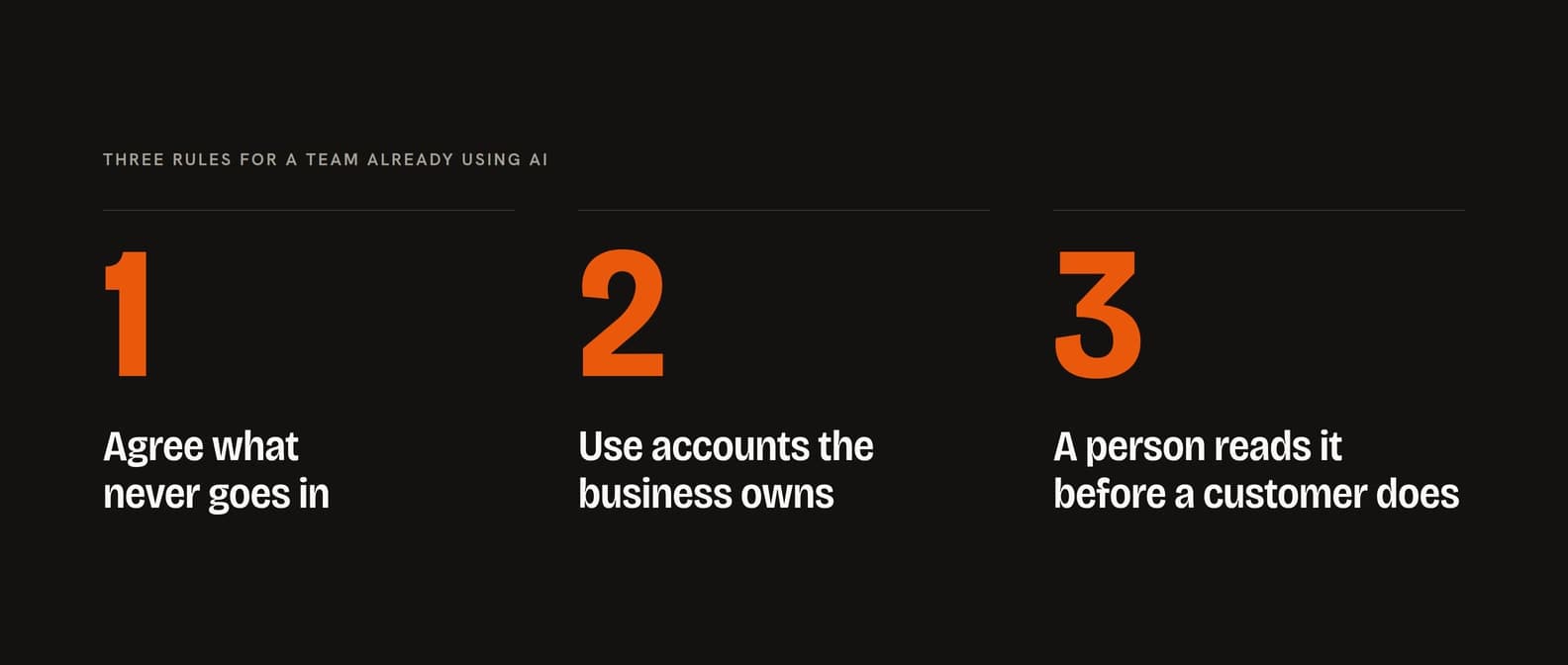
1. Agree what never goes in
Write a short list and share it. For most small businesses it looks something like this:
- Customer names with anything personal attached: health details, home addresses, phone numbers, account numbers.
- Anything a customer told you in confidence.
- Passwords, banking details and anything from payroll.
- Contracts and prices you haven't agreed to share.
Some free and personal accounts can use what you type to improve future versions of the tool unless someone switches that off. Business accounts usually don't by default, but settings change, so check the ones your team actually uses.
2. Use accounts the business owns
If a tool matters to how the work gets done, pay for it in the business's name, not on someone's personal card. Then you control the settings and can see who has access, and when someone leaves, their access leaves with them while the work they did stays with you.
3. A person reads it before a customer does
AI writes confidently even when it's wrong. It can invent a policy, promise a date nobody agreed to, or get a name slightly off. So anything going to a customer gets read by a person first. It's one of the ground rules we build every client set-up on, and it's the easiest one to keep.
The part nobody enjoys
Canada has privacy laws for businesses. The federal one is called PIPEDA, and British Columbia, Alberta and Quebec each have their own. They apply to what goes into an AI tool just as they apply to anything else you do with customer information. What that means for your business is a question for your lawyer, and it's worth asking before a mistake rather than after one.
Making it a habit
Rules on a page fade. What sticks is an afternoon where your team tries the tools on real work with the rules in front of them, and sees where it helps and where it doesn't. That's what our Team Workshop is for. If you'd rather talk it through first, the free 20-minute AI Fit Call is there for that.