Where AI helps a small business, and where it doesn't
The useful jobs are rarely the exciting ones. A plain way to spot the work worth handing over, and the work that should stay with a person.
Most conversations about AI start with the tool. Someone saw a demo, a competitor mentioned it, or a subscription is already running and nobody is quite sure what it's for. The better place to start is your own week: the jobs that take time, come round again and again, and go the same way each time.
The jobs worth a closer look
AI is good at a narrow kind of work. It reads, sorts, summarizes and drafts, quickly, and it doesn't get bored. So the jobs where it tends to help have a few things in common:
- They happen often. A task you do twice a year isn't worth setting anything up for.
- They follow a pattern: the same questions, the same kind of email, the same form filled in the same way.
- They're mostly words. Enquiries, quotes, notes, summaries, replies and reports.
- A mistake is easy to catch. A draft someone reads before it goes out is low risk. A payment that goes out on its own is not.
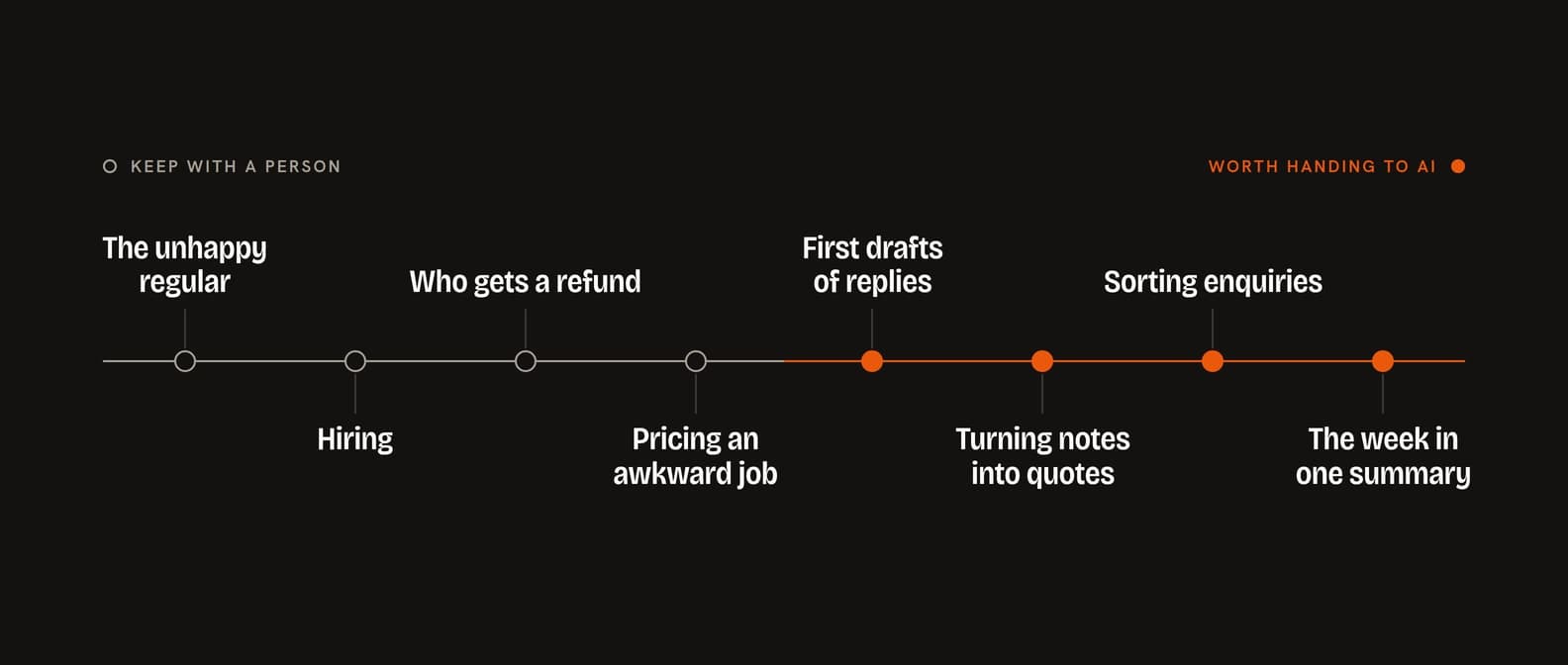
In a small business that usually means sorting and answering enquiries, turning notes into quotes or follow-ups, pulling the week's figures into one summary, or finding an answer that's buried somewhere in your own documents.
The jobs to leave alone
Some work should stay with a person, and not because the technology can't attempt it.
- Anything that rests on a relationship. The call with a long-standing customer who is unhappy is not a writing task.
- Judgement calls with real consequences: pricing an awkward job, hiring, deciding who gets a refund.
- Rare jobs. If it happens once a quarter, doing it by hand is cheaper than setting anything up.
- Work where a mistake would reach a customer before anyone could catch it.
A good test: if you'd be uncomfortable telling a customer that a machine did it and nobody looked, keep a person on it.
Start with the job, not the tool
Once you have a short list, describe each job in plain words before you look at any product: what comes in, what has to happen, what goes out, and who checks it. If you can't describe it, no tool will fix it, because the work itself isn't clear yet. That's worth knowing too.
Then write down how long the job takes now and how often it comes round. Without those two numbers you can't tell later whether anything improved, and a tool that feels helpful can quietly cost more time than it saves.
If you're not sure where to start
That's what the free 20-minute AI Fit Call is for. We ask about your week and tell you honestly whether there's anything worth doing. Sometimes the answer is not AI, and we'll say so.